
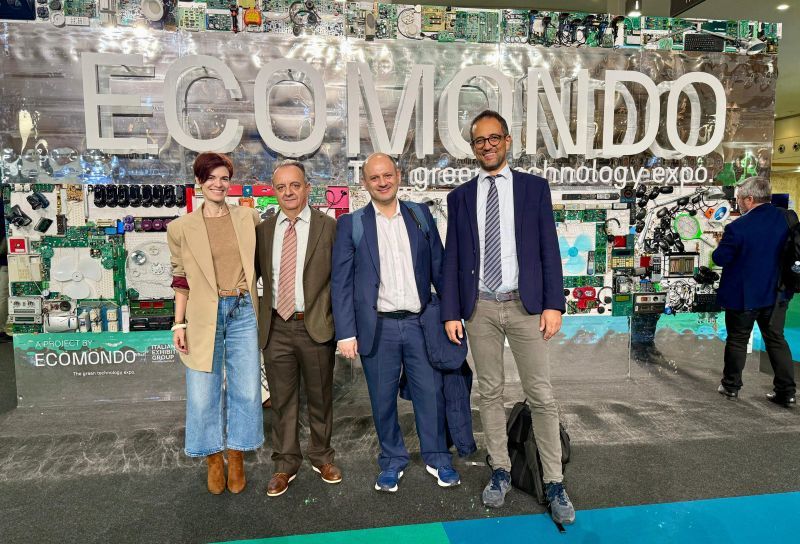
The CSSBoost project successfully participated in the Ecomondo 2025 Exhibition in Rimini, sharing insights into the advancement of circular systemic solutions. During the special session “European and Mediterranean nature-based, digital and cyber-physical initiatives projects to innovate water management”, the project coordinator, Prof. George Arampatzis provided an overview of CSSBoost’s dedicated goals to overcoming critical technological and non-technological circular economy barriers by bridging the gap among digital innovation, green transition and social inclusion at regional level, highlighting the significance of fostering the triple transition across European territories.
CSSBoost introduced one of its five key demonstrators, the Water Reuse and Nutrients Recovery Circular Systemic Solution, located in the region of Marche in Italy, as a real-world living lab that supports in action the Water Resilience Strategy (WRS) to build a “water-smart” economy through circularity and innovation. The WRS identifies the fragmentation of water management and a lack of shared data as critical vulnerabilities, calling specifically for the deployment of digital tools and innovations to accelerate sound water management. To this end, the CSSBooster, the project’s core outcome, is designed to virtualise, monitor, and manage the entire regional ecosystems of the CSSBoost’s five key demonstrators, to enable robust, multi-stakeholder governance.
The necessity of empowering digital innovation and cyber-physical solutions was underlined by the session’s participants, representing DG RTD of the European Commission, ISPRA (Italian Institute for Environmental Protection and Research), and several European Initiatives (CSSBoost, SEACURE, CARDIMED, and LIFE Turbines). The session was moderated by Prof. Francesco Fatone, leader of the CSSBoost Italian Pilot and Technical Scientific Committee of Ecomondo 2025, who underscored the regional systemic solutions as a powerful tool towards the circular transition at the European level.