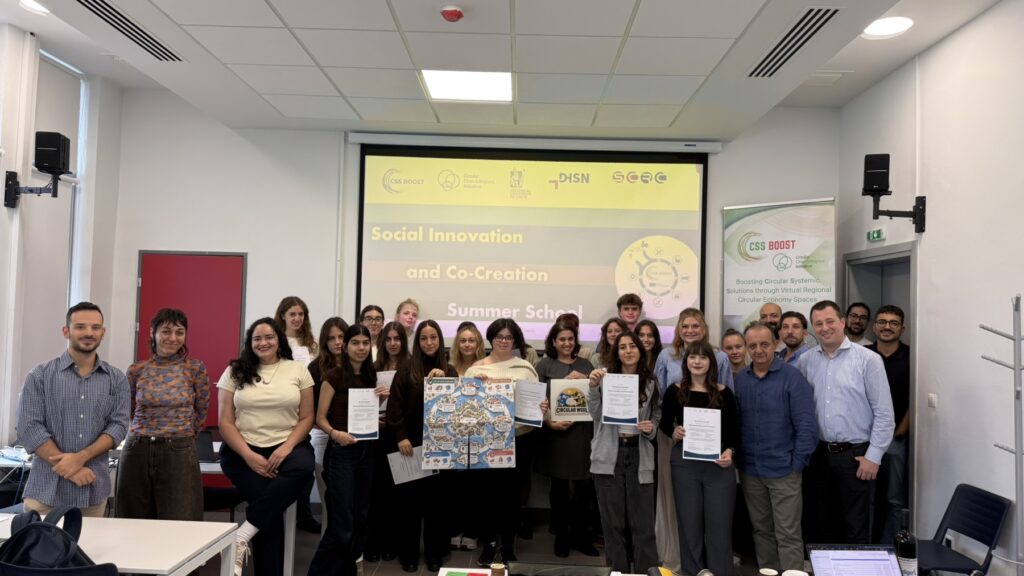
From September 28 to October 2, 2026, the Technical University of Crete (TUC) hosted the CSSBoost Interdisciplinary Summer School: Social Innovation and Co-Creation in Chania, Greece. Organized jointly by the Social CRM Research Centre (SCRC Leipzig), TUC, and the Duale Hochschule Sachsen (DHSN), the five-day intensive brought together 21 European students across multiple disciplines to transform circular economy theory into tested, real-world solutions.
Grounded in CSSBoost Pilot 1—which focuses on agri-food valorisation and by-product loops in Crete—the programme bridged systemic analysis, site exploration, and hands-on digital prototyping.
From Field Insights to Rapid Prototyping
The curriculum pushed participants beyond conventional lectures by combining academic rigour with rapid fabrication:
- Day 1 (Foundations): Immersive seminars on Circular Systemic Solutions (CSS), social innovation spirals, and community relationship management.
- Day 2 (Field Experience): A site visit to Pilot 1 facilities in Crete (MACC and Mills of Crete), enabling students to inspect raw material flows, interview operators, and collect empirical data on local by-product streams.
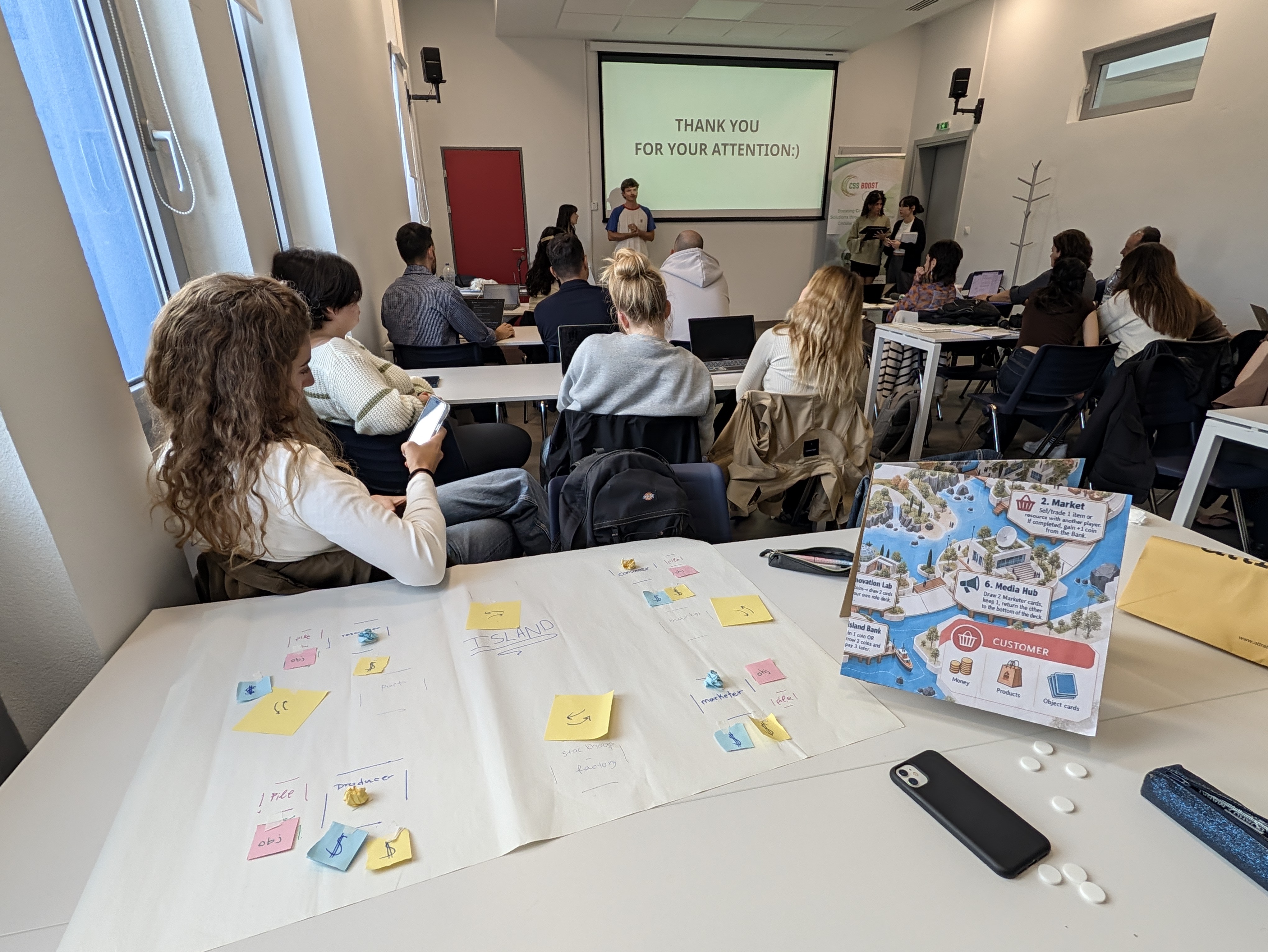
- Day 3 (Human-Centred Design): Applying Design Thinking methodologies, stakeholder persona mapping, and game mechanics to solve Pilot 1 bottlenecks.
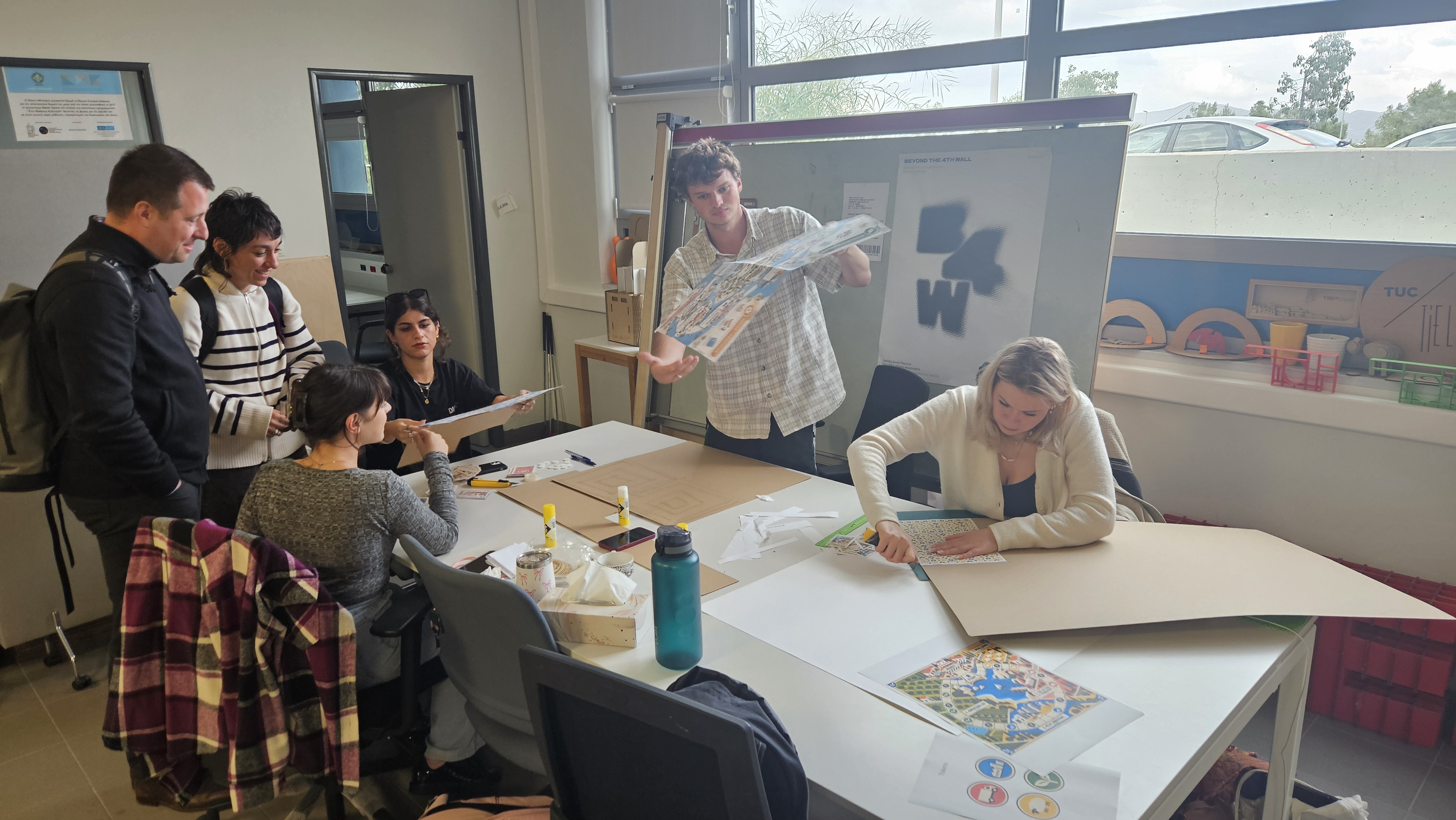
- Day 4 (FabLab Prototyping): A full working day inside TUC’s makerspaces, utilising 3D printers, laser cutters, and visual design tools to fabricate physical game boards, tokens, and digital interfaces.
- Day 5 (Showcase): Final pitches where multidisciplinary student teams presented ready-to-test concepts to the consortium’s scientific and technical panel.
Challenge 1: Stakeholder Communities on We.Network
Addressing stakeholder engagement in Pilot 1, teams designed digital activation strategies for the open European platform We.Network:
- 5 Online Community Frameworks: Structured models connecting shepherds, farmers, olive oil producers, and researchers.
- 15 Plug-and-Play Content Templates: Sample campaigns developed for direct community testing.
- Featured Initiative — Waste2Growth: A dedicated sub-community concept focusing on transforming discarded raw sheep wool into moisture-retaining soil amendment pellets. The student campaign highlighted clear agricultural metrics: retaining up to 20% more water in arid soils, providing slow-release nitrogen, and eliminating regional agricultural waste.
Challenge 2: Serious Games for Systemic Circularity
To teach audiences aged 14+ how circular value chains function, student teams delivered one video game prototype, two fully playable tabletop board games, and three comprehensive game concepts:
1. Circularity Island (Tabletop Board Game)
- Designers: Tony Valentino Böhm, Konstantina Christofi, Evangelia Daskalaki, and Katerina Papadopoulou.
- Core Mechanics: Players inhabit a closed island ecosystem with finite natural resources. Operating under asymmetric roles—Resource Provider, Maker, Marketer, and Customer—participants must trade materials and generate “Circularity Points” (CP). Victory is collective: individual objectives cannot be fulfilled unless the island’s overall environmental system remains balanced.
2. Uncle John’s Farm (Interactive Videogame Prototype)
- Designers: Anastasia Vezyraki, Ianthi Spinaki, Nele Madeleine Adelhardt, Konstandina Ago, and Maria Palaiou.
- Core Mechanics: An agricultural management simulator where players inherit a traditional farm. The gameplay contrasts linear trade-offs (e.g., buying synthetic fertilizer, burning crop residue) with circular interventions (e.g., on-farm composting, utilizing nitrogen-fixing fava roots, feeding by-products to livestock). A dynamic status bar tracks the farm’s circularity level across changing seasons.
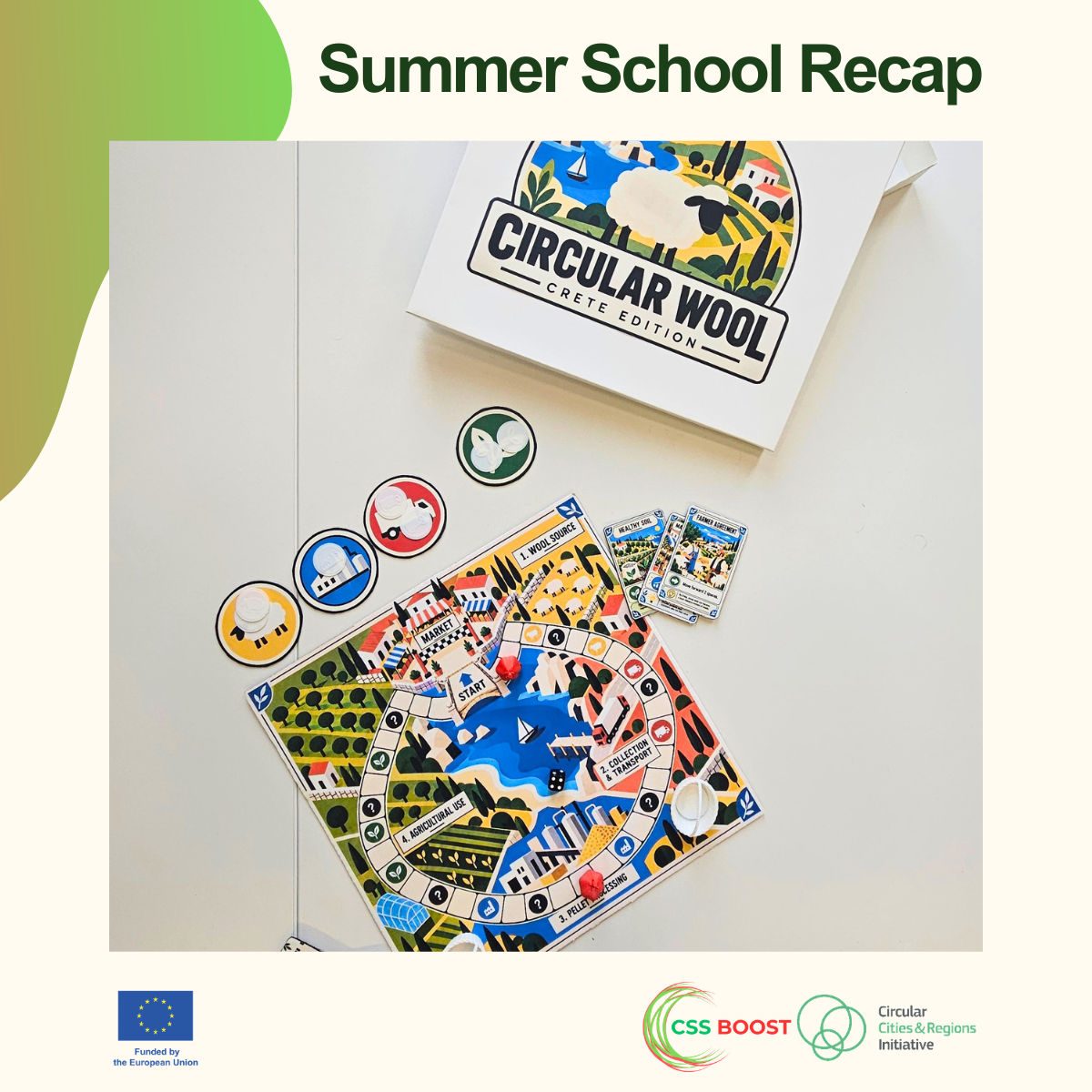
3. Circular Wool: Crete Edition (Strategic Board Game)
- Designers: Lucie Marie Weber, Eleni Kontompasi, Emmanouela Mamantaki, and Ioanna Stefanou.
- Core Mechanics: A board game simulating Pilot 1’s exact four-stage valorization cycle: Wool Source $\rightarrow$ Collection & Transport $\rightarrow$ Pellet Processing $\rightarrow$ Agricultural Use. Players draw action cards featuring real-world logistics challenges (e.g., transport delays, processing access) and must collaborate to close loops. The governing rule reinforces systemic thinking: speed alone is insufficient; the whole value chain must cooperate for any player to reach the market.
Integrating Results into CSSBoost
The prototypes produced during the Summer School will not remain theoretical exercises. The five community concepts will directly inform the live CSSBoost Communities of Practice running on We.Network, while the serious game prototypes are under evaluation for integration into the project’s open Learning Management System (LMS) and replication toolkits.