
Water Reuse and Nutrients Recovery
Technology Description
Pilot 2 focuses on establishing a centralized circular hub that transforms wastewater treatment from a disposal process into a resource recovery engine. Located within the CIIP (Cicli Integrati Impianti Primari) service area in Italy, this pilot demonstrates how municipal and industrial wastewater, along with sewage sludge and organic waste, can be valorized to produce safe irrigation water, renewable energy, and high-quality bio-fertilizers.
The solution integrates Nature-Based Solutions (NBS) with advanced thermal drying and thermo-chemical processes to close the loop on the water-energy-food nexus.
Visualising the Solution
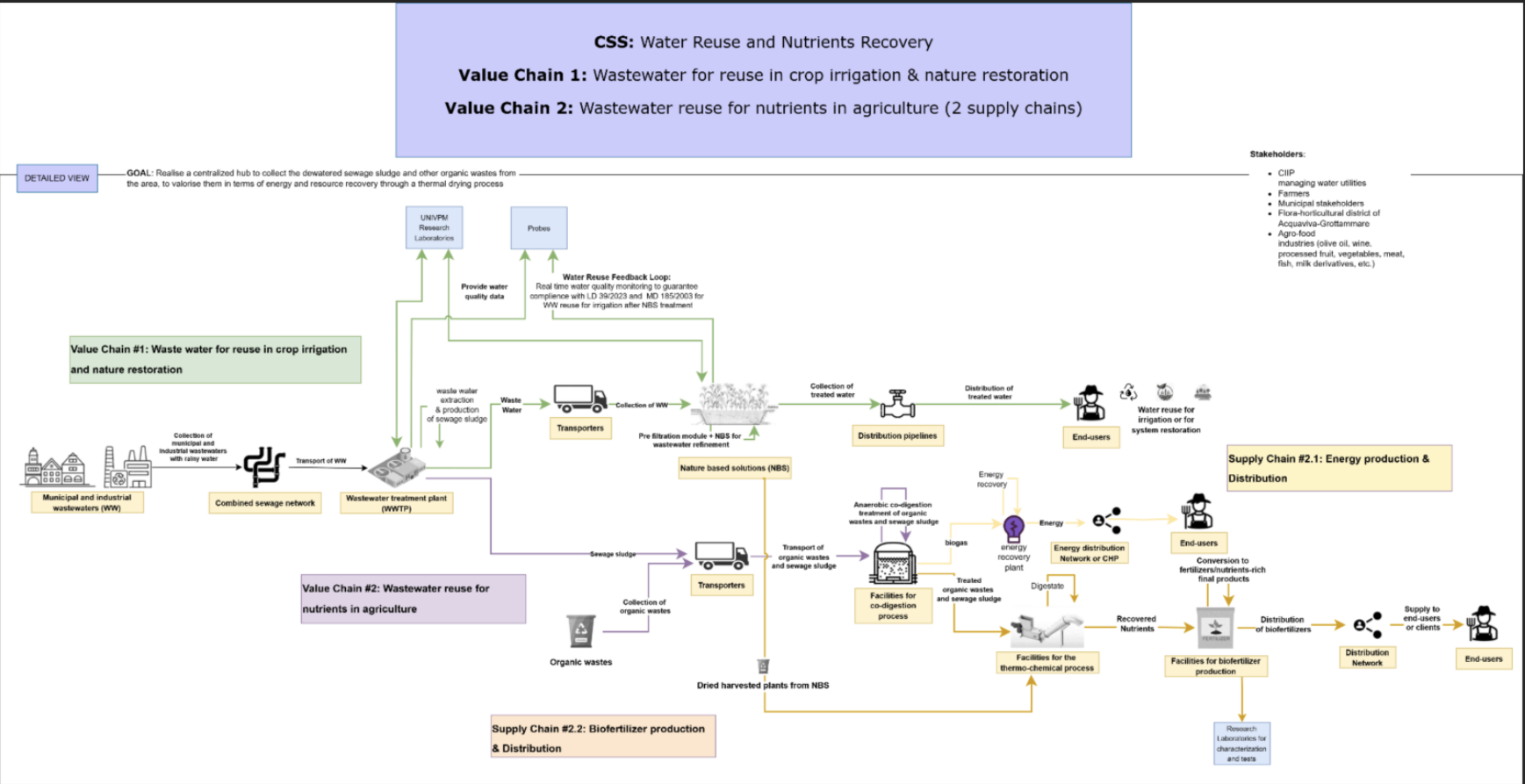
Key Innovation: The “symbiotic” link in which plants grown to clean the water (NBS) are harvested and used as a carbon source to produce bio-fertilizer in the second value chain.


Value Chain 1
This value chain addresses water scarcity by refining treated wastewater to high-quality standards suitable for agriculture and ecological restoration.
The Process: Wastewater from the Treatment Plant (WWTP) undergoes tertiary treatment via a Nature-Based Solution (NBS) module (e.g., constructed wetlands/phytoremediation) for refinement.
Safety & Monitoring: A robust “Water Reuse Feedback Loop” utilizes real-time probes and analysis by UNIVPM Research Laboratories to ensure the water meets strict safety standards (LD 39/2023 and MD 185/2003).
End Use: The refined water is distributed to the Flora-horticultural district of Acquaviva-Grottammare for crop irrigation and used for restoring local natural systems.
Value Chain 2
This value chain valorizes the solid by-products of the water treatment process (sewage sludge) and other organic wastes.
Supply Chain 2.1 (Energy): Sewage sludge and organic waste undergo anaerobic co-digestion to produce biogas. This biogas is converted into renewable energy to power the treatment facilities, reducing external energy dependency.
Supply Chain 2.2 (Bio-fertilizers): The solid digestate is combined with dried harvested plants (biomass collected from the NBS in Value Chain 1). This mixture undergoes thermal drying and thermo-chemical processing to recover nutrients (N, P, K), creating a high-value bio-fertilizer distributed to local farmers as a sustainable alternative to synthetic fertilizers.
Objective & Impact
The primary goal is to realize a centralized hub that valorizes dewatered sewage sludge and organic wastes through thermal drying and energy recovery.
Environmental: Reduction of freshwater withdrawal for irrigation; restoration of natural systems; safe return of nutrients to the soil.
Economic: Reduction of external energy purchases for the WWTP; creation of local market streams for bio-fertilizers.
Technical: Demonstration of efficient anaerobic co-digestion and thermo-chemical nutrient recovery at an intermediate regional scale.